
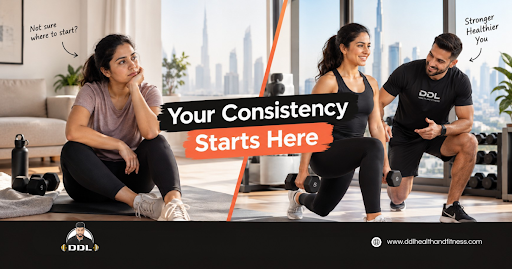
Starting a fitness routine is often easier than maintaining one. Busy schedules, unclear goals, limited gym experience and inconsistent motivation can quickly turn a promising workout plan into another abandoned routine. This is where Private Fitness Training in Dubai can make a practical difference.
Consider a common client journey: someone starts with little structure, struggles to stay consistent and feels unsure about what to do in the gym. Instead of chasing rapid results, the focus shifts towards building sustainable habits, learning correct exercise techniques and creating a routine that fits real life.
At DDL Health And Fitness, this type of journey is built around individual needs rather than a one-size-fits-all programme. The aim is not simply to complete workouts, but to make exercise a repeatable part of everyday life.
This article explores how a client can move from an uncertain starting point to workout consistency, what personalised coaching involves, and how a Tailored Fitness Plan can support measurable progress.
|
Table of Contents
|
1. Where the Fitness Journey Begins
Every Fitness Transformation Journey starts somewhere. For many people, the first challenge is not physical ability but uncertainty.
A beginner may wonder which exercises to perform, how often to train or whether a particular movement is being done correctly. A more experienced person may understand exercise but struggle to maintain a regular schedule.
A sensible starting point includes:
- Establishing the baseline: Understand current fitness, movement ability, training experience and lifestyle.
- Defining realistic goals: Goals might include strength, mobility, cardiovascular fitness, body composition or general wellbeing.
- Identifying obstacles: Work commitments, travel, fatigue and lack of confidence can all affect adherence.
- Starting gradually: A manageable routine is usually easier to maintain than an overly demanding programme.
The World Health Organization recommends that adults undertake 150 – 300 minutes of moderate-intensity aerobic activity each week, or an equivalent amount of vigorous activity, alongside muscle-strengthening activity on at least two days per week. These are general guidelines, not a prescription for every individual.
What does a successful starting point look like?
It does not necessarily mean completing the hardest workout. It means knowing what to do next and having a realistic reason to return for the next session.
2. Why Personalised Coaching Can Improve Consistency
Consistency is easier when a person understands their routine and receives appropriate guidance.
Private Fitness Training in Dubai provides an opportunity for a trainer to focus on one client at a time. That can make it easier to adjust exercise selection, training intensity, technique and session structure according to the individual’s needs.
Three factors are particularly useful:
- Accountability: A scheduled session creates a clear commitment.
- Technique feedback: A trainer can help clients learn movement patterns and exercise form.
- Progressive training: Exercises can become gradually more challenging as ability improves.
- Adaptability: Sessions can be modified around changing schedules, fitness levels or training preferences.
For example, a beginner who finds traditional strength training intimidating might initially use basic movement patterns, controlled resistance exercises and mobility work. As confidence develops, the programme can progress towards more demanding exercises.
This is one of the practical advantages of Private Gym Coaching: the session can respond to the person rather than expecting the person to fit a fixed class format.
3. Building a Tailored Fitness Plan
A Tailored Fitness Plan should connect the client’s goals with realistic training habits.
Rather than selecting random exercises, a trainer can organise sessions around key training components such as:
- Strength and resistance training
- Cardiovascular conditioning
- Mobility and flexibility
- Core stability
- Recovery and rest
- Functional movement
A practical progression
A structured plan may develop through four stages:
1. Foundation: Learn basic movement patterns, establish technique and become comfortable with training.
2. Routine: Create regular sessions that fit around work and personal commitments.
3. Progression: Gradually adjust resistance, repetitions, exercise complexity or training volume.
4. Maintenance: Develop habits that can continue after the initial transformation phase.
This approach also supports safer progression. The Dubai Health Authority’s 2026 Physical Activity Guidelines describe fitness as including areas such as cardiorespiratory endurance, muscular strength, flexibility, balance and body composition.
4. From Occasional Workouts to a Routine
The biggest change in a Fitness Transformation Journey may not be a visible physical change. It may be the moment exercise stops feeling like an occasional task and becomes part of the weekly routine.
Five ways to strengthen workout consistency
- Set fixed training times
Treat sessions like other important appointments. - Keep the first target achievable
Consistency should come before adding unnecessary training volume. - Track simple measures
Record sessions completed, weights used, repetitions, walking time or other relevant measures. - Plan around real life
A routine should account for work, travel, family commitments and recovery. - Review regularly
A programme that no longer matches a client’s needs should be adjusted.
Pro Tip
Don’t judge a programme only by how exhausting each session feels. A good routine should challenge you while remaining realistic enough to repeat week after week. Long-term adherence is often more useful than repeatedly starting an extreme programme.
5. Private Gym Coaching vs Going It Alone
Both independent training and personal coaching can work. The right choice depends on experience, goals, confidence and the level of support required.
| Feature | Independent Gym Training | Private Gym Coaching |
|---|---|---|
| Programme design | Self-planned | Trainer-led |
| Exercise technique | Self-monitored | Personal feedback |
| Accountability | Mainly self-driven | Scheduled support |
| Progress adjustments | Client decides | Trainer can modify |
| Personalisation | Depends on knowledge | High |
| Beginner support | Can be challenging | More structured |
For someone who already understands training principles, independent exercise may be perfectly suitable. For a beginner or someone repeatedly struggling with adherence, Private Gym Coaching can provide structure and accountability.
The important question is not which option sounds better, but which approach a person can follow consistently.
6. Measuring Progress Beyond the Scales
A sustainable Fitness Transformation Journey should not depend entirely on body weight.
Useful indicators can include:
- Improved exercise technique
- Increased strength or endurance
- Better mobility
- More completed training sessions
- Improved confidence in the gym
- Greater ability to perform everyday activities
- Improved consistency with planned exercise
A simple consistency checklist
- Define one or two primary fitness goals
- Choose realistic weekly training times
- Follow a structured programme
- Record key training progress
- Allow adequate recovery
- Review the plan regularly
- Adjust rather than abandon the routine
A client who initially struggled to train once a week may eventually build a regular schedule. That behavioural change can be an important milestone even before dramatic physical results appear.
At DDL Health And Fitness, the value of individual coaching lies in helping clients understand that progress is a process. Training can then evolve as the client becomes stronger, more confident and more familiar with exercise.
Frequently Asked Questions
1. What is Private Fitness Training in Dubai?
Private Fitness Training in Dubai is one-to-one fitness coaching where sessions are designed around an individual’s goals, current ability and lifestyle. A trainer can provide exercise instruction, technique feedback, programme adjustments and accountability, helping the client follow a structured approach rather than relying entirely on self-directed workouts.
2. Is Private Fitness Training suitable for beginners?
Yes. Private coaching can be particularly useful for beginners who are unsure how to use gym equipment or structure their workouts. Sessions can start with fundamental movements and manageable workloads before progressing. The trainer can also explain exercise technique and adapt the programme as the client’s confidence and ability improve.
3. How often should I have personal training sessions?
There is no single frequency suitable for everyone. The appropriate schedule depends on goals, experience, recovery, availability and other physical activity. A practical programme should fit the client’s lifestyle. WHO recommends regular aerobic activity and muscle-strengthening activity on at least two days each week for adults.
4. Can personal training help with workout consistency?
It can provide structure and accountability, which may make regular training easier to maintain. Scheduled sessions create a commitment, while a trainer can modify workouts when circumstances change. However, long-term consistency still depends on the client’s habits, availability and willingness to follow the agreed programme between sessions.
5. What should a Tailored Fitness Plan include?
A Tailored Fitness Plan should reflect the client’s goals, fitness level, training experience and lifestyle. Depending on the individual, it may combine resistance training, cardiovascular exercise, mobility, core work and recovery. The plan should also include a sensible progression strategy rather than simply increasing exercise intensity as quickly as possible.
6. How long does a Fitness Transformation Journey take?
There is no fixed timeline because results depend on the starting point, goals, training consistency, nutrition, recovery and individual factors. A useful approach is to focus first on building sustainable habits and tracking meaningful improvements. Physical changes can then be considered alongside strength, endurance, mobility and overall training consistency.
Conclusion
Moving from zero to consistent does not require an extreme fitness routine. It requires a clear starting point, realistic goals, appropriate progression and enough structure to keep going when motivation changes.
Private Fitness Training in Dubai can provide that structure through individual attention, exercise guidance, accountability and a programme adapted to the client. The most valuable outcome may not be a short-term transformation, but the ability to train confidently and consistently as part of a sustainable lifestyle.
A Tailored Fitness Plan can help connect individual goals with practical weekly habits, while Private Gym Coaching can provide the support needed to refine technique and adjust training over time.
DDL Health And Fitness can help clients approach their Fitness Transformation Journey with a structured and individualised strategy rather than relying on guesswork.
If you are ready to move from inconsistent workouts to a routine you can realistically maintain, contact DDL Health And Fitness to discuss your goals and explore a suitable private training approach.